Handheld vacuums and emptying access
A handheld vacuum is often chosen for quick jobs, so emptying and putting it away should be quick too. Compare the bin opening, filter access and charging location before focusing on a headline power figure.
Name the small jobs
List where the handheld vacuum will be used: dry crumbs on a table, debris in a drawer or a car interior. Check that the model is intended for those materials and locations. A compact vacuum is not automatically approved for liquids, hot debris or fine building dust. Its manual defines the permitted use, not the size of the nozzle.
Try holding the device at the angles those jobs require. Weight at the handle can feel different from the total weight in a specification. A long nozzle may reach a gap but make the device harder to balance. Compare the whole working combination, including the attachment, rather than lifting only the bare motor unit.
Open the bin before buying
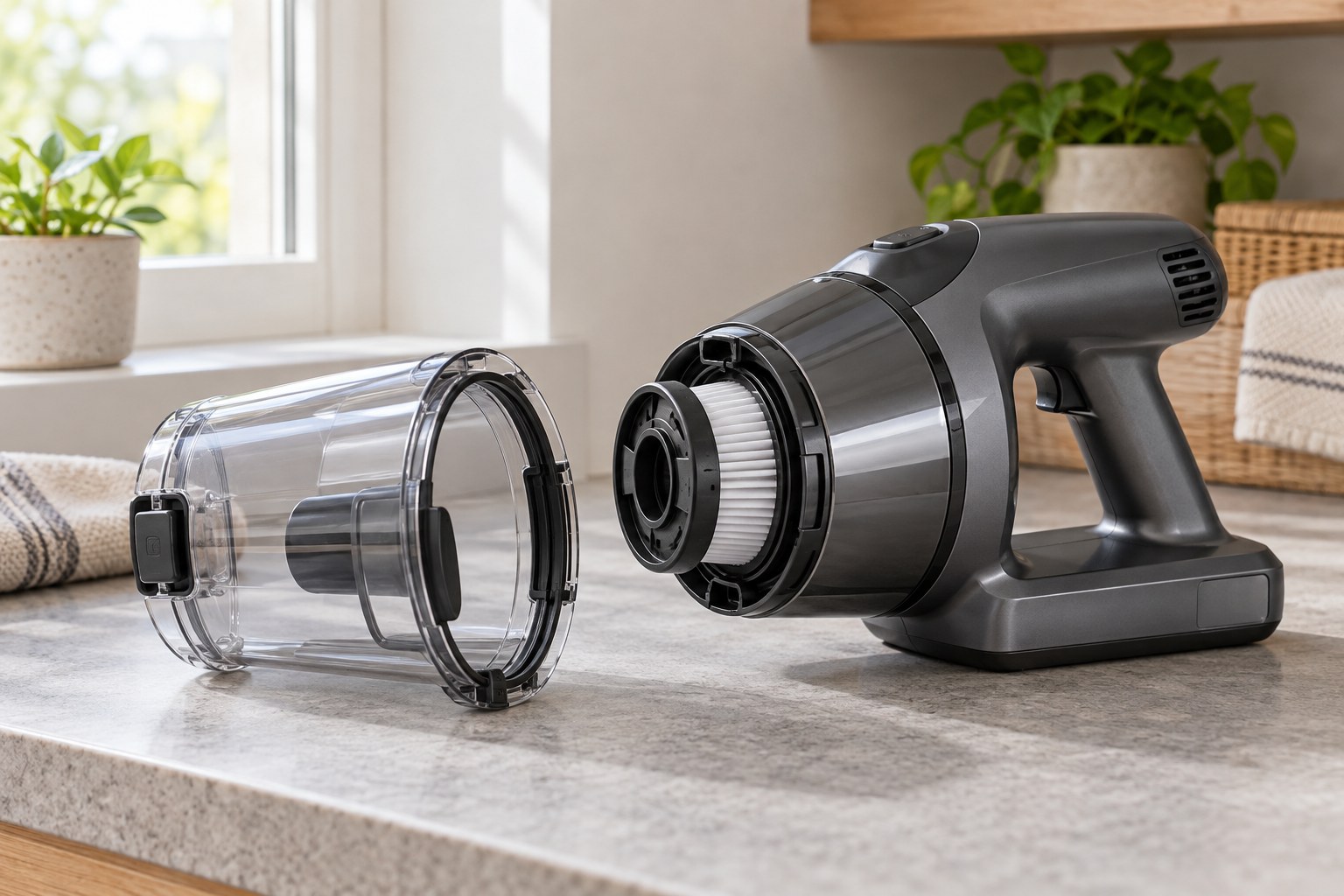
Look at the emptying motion and the clearance needed over a waste container. Does the bin detach, open downward or require a filter to be removed first? Try the mechanism with the device safely switched off. The release should be easy to distinguish from an attachment button so the contents are not accidentally dropped during use.
Check corners and narrow passages where debris can remain. A large capacity is less useful if emptying requires frequent contact with trapped material. Read the cleaning instructions for the bin separately from the motor body and filters. A washable container does not mean the entire device can be rinsed.
Understand the filter routine
Find the exact filter type, replacement reference and cleaning instructions. Washability varies by model. Dyson's filter-care guidance, for example, requires complete drying before refitting its washable filters and directs users to model-specific instructions. Do not transfer one brand's wash temperature or drying method to a different handheld vacuum.
Include the time when a cleaned part cannot yet be reinstalled. If the vacuum is needed frequently, a compatible spare may be useful where the manufacturer supports it. Do not run the cleaner without a required filter simply because the original is drying. Keep the part code and the maintenance steps with the household equipment notes.
Give charging and storage an actual place
Measure the device in its dock or with the charging cable connected. A wall mount needs a suitable surface and the prescribed fixings; a shelf needs enough room to remove the vacuum without pulling the lead. Use the supplied or explicitly approved charger and follow the battery-care instructions.
Store attachments where they can be found with the vacuum. After a trial week, notice whether the bin is emptied promptly or postponed because the mechanism is awkward. The most useful handheld model is the one whose entire routine remains convenient: retrieve, clean the permitted mess, empty, maintain and return it to a sensible charging place.