Freezer boxes that stack neatly
A freezer box needs to work in a crowded drawer, where its label may be the only visible part. Choose containers around realistic portions and the way you retrieve them, then check their suitability for freezing.
Measure the drawer with the lid included
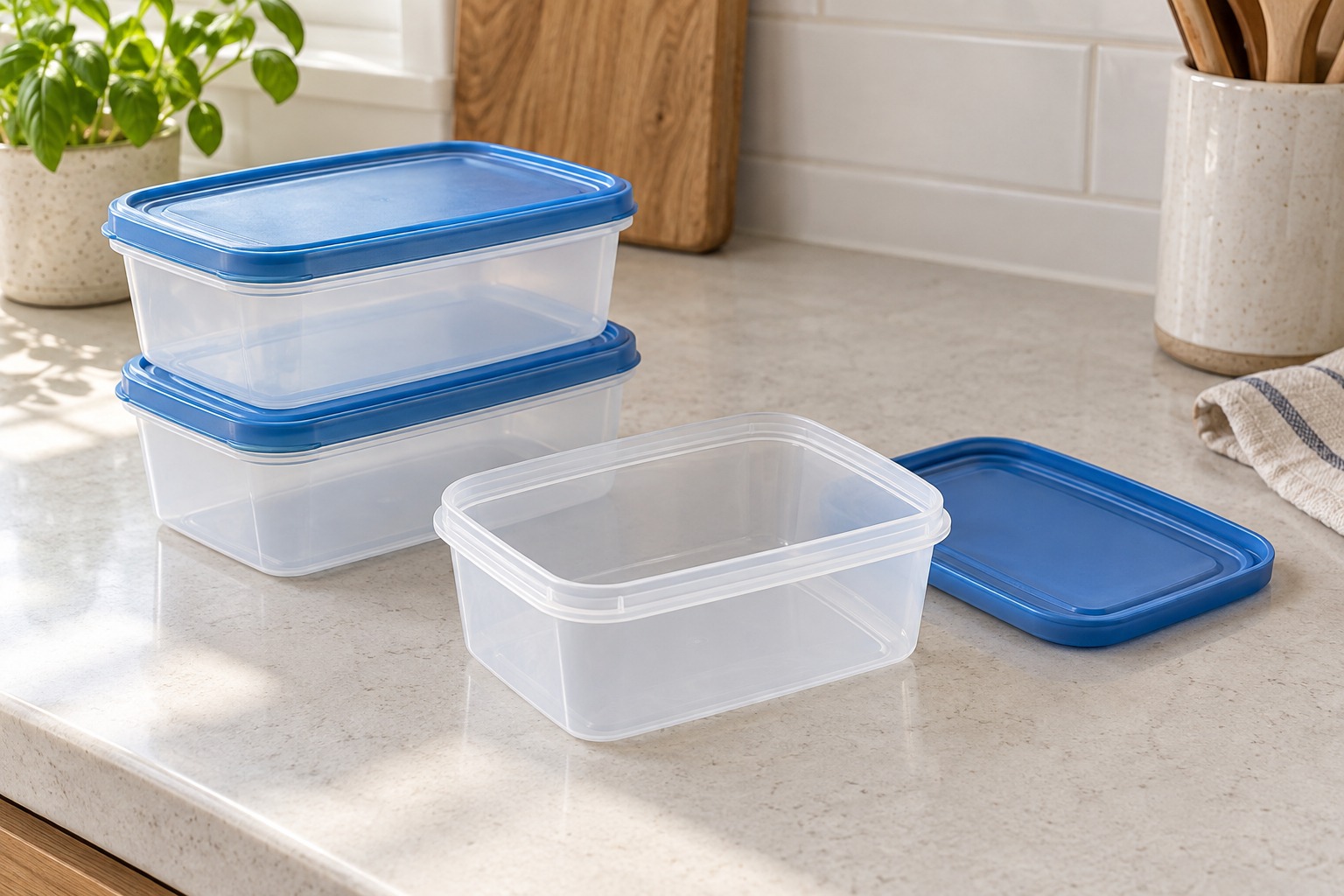
Measure the usable depth, width and height of the drawer, allowing for its sloping sides and any obstruction above it. Product measurements may describe the body rather than the complete closed container. A projecting clip can stop two apparently suitable boxes sitting side by side. Use paper rectangles to explore a few arrangements before buying a whole matching set.
Leave enough room to lift out a single box without tipping its neighbors. Tall towers can look efficient but make the bottom portion awkward to retrieve. Two layers of shallow containers may be easier to manage than several deep boxes, depending on the drawer. Keep different shapes in separate areas rather than balancing a narrow base on a wider lid that provides no locating edge.
Freezer suitability and space for expansion
Look for an explicit freezer use statement on the exact container and lid. A general food storage description does not establish suitability for every temperature. Check any restrictions for glass, seals and clips as separate components. Freezer suitability also does not establish that a frozen container can go straight into an oven or microwave; follow the maker's instructions for transitions and reheating.
The National Center for Home Food Preservation explains that most foods need headspace to allow for expansion during freezing. Follow the guidance appropriate to the food and container rather than filling every box to the rim. The usable portion is therefore smaller than the advertised maximum volume. If a normal serving only fits when the lid touches the contents, choose a larger size or divide the serving.
Organize for recognition and rotation
Choose a label position that remains visible in the actual drawer. A top label is little help under another container; a side label may disappear behind a deep drawer wall. Write the contents and packing date clearly, using labels intended to stay attached under the relevant conditions. Keep the writing away from sealing surfaces and any markings needed to identify the box.
A simple map can reserve one area for ready portions and another for ingredients. New packages should not bury earlier ones indefinitely. Bring forward items that need using according to suitable storage guidance, without treating the date label as proof that every food keeps for the same period. A familiar arrangement is useful only if everyone returning boxes follows it.
Open and clean without forcing parts
Frozen clips and tight lids should be handled according to their instructions. Do not twist a box aggressively or pry at it with a knife because it is difficult to open. A design with broad accessible tabs may suit your hands better, but test the movement before purchase where possible and remember that empty room-temperature handling cannot prove its frozen performance.
After use, check corners, lids and seals for damage while washing as directed. Keep spare lids only when their compatibility is certain. If a size is useful, record its model before buying replacements, since a similar-looking range may have different dimensions. A small selection of stable, recognizable portions is easier to use than a drawer packed with every possible container size.