Recycling boxes that stack sensibly
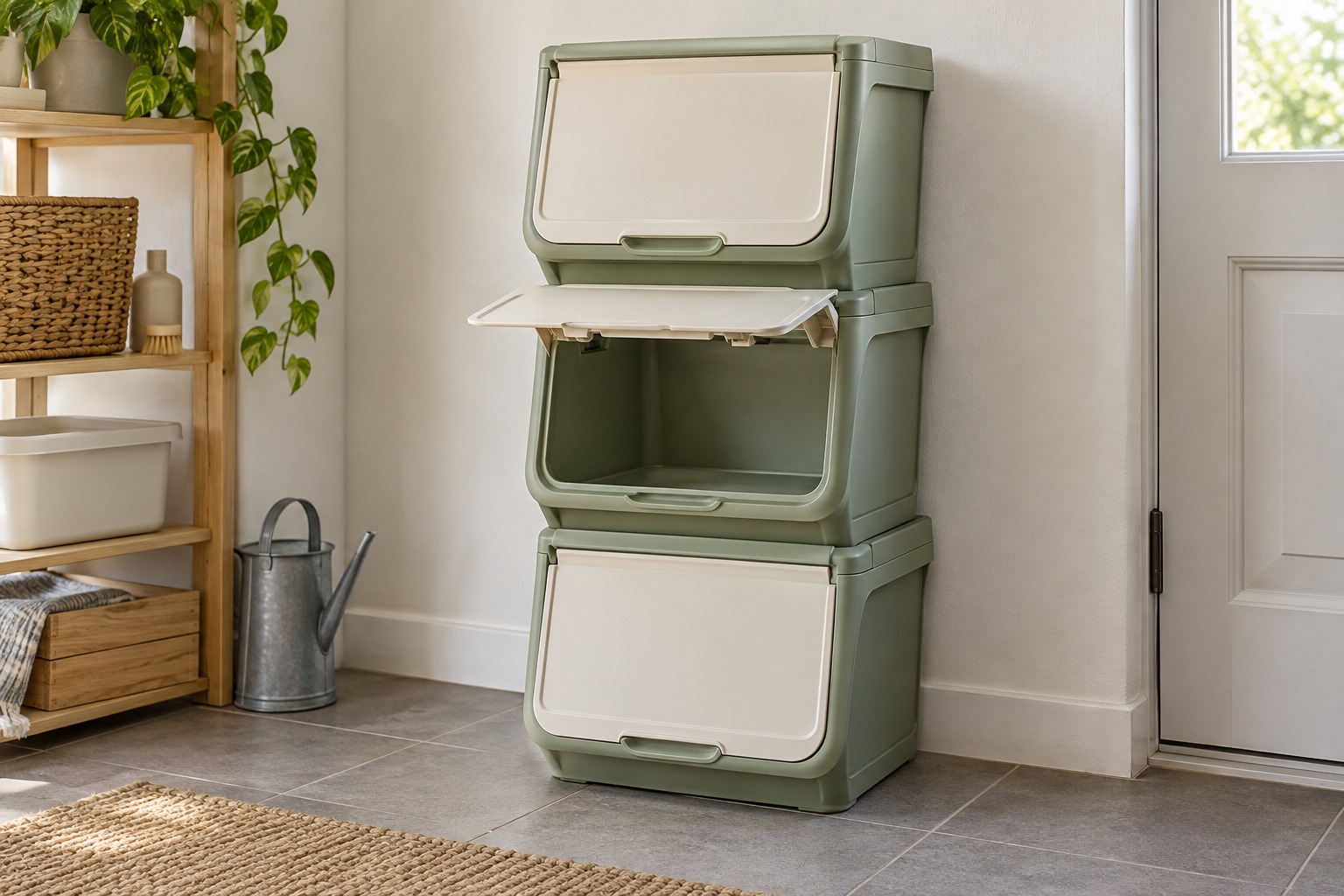
Stacking recycling boxes can save floor space, but the lower containers still have to be filled and emptied. Plan the stack around access and your local collection system before choosing its height.
Sort according to your local service
Use the categories accepted by your actual collection provider. Packaging labels and container colors are not a substitute for local instructions. Decide which streams need indoor storage and which can go directly to an outside container. Give the most frequently used category a convenient opening, rather than assigning identical box sizes simply to make the stack symmetrical.
Estimate the volume produced between collections from your own household. Flatten permitted items where appropriate, but follow local preparation guidance rather than assuming every material should be treated the same way. Keep the arrangement flexible if collection schedules or household needs change. Removable labels are more useful than permanent labels that lock a container into an unsuitable role.
Look at access when fully stacked
A lid that opens upward may be unusable beneath another box. Front-opening flaps can solve this, but the opening must be large enough for the items you actually place inside. Check that the upper container is supported by the intended stacking points. Similar dimensions do not establish that boxes from different ranges can be safely stacked together.
Respect the manufacturer's stack-height and load limits. Put heavier contents where the design specifies and use any required securing method. A tall stack should not block doors or become a climbing opportunity. If the only way to empty the bottom container is to lift several heavy boxes, a lower arrangement or separate side-by-side units may be the more workable choice.
Make emptying and cleaning independent
Check handles with the boxes in their normal position. A carrying handle hidden by the next container cannot help until the stack is dismantled. Consider where each box will be set down during emptying, and keep the route to the collection point clear. Removable liners should be compatible with local sorting requirements as well as the container's dimensions.
Choose surfaces you can clean using the manufacturer's method and let containers dry before restacking where needed. Avoid storing leaking residues simply because a lid hides them. Inspect stacking tabs and hinges for damage. The successful system is one that can be sorted, carried and cleaned in ordinary use, not merely one that forms a neat tower when every box is empty.